
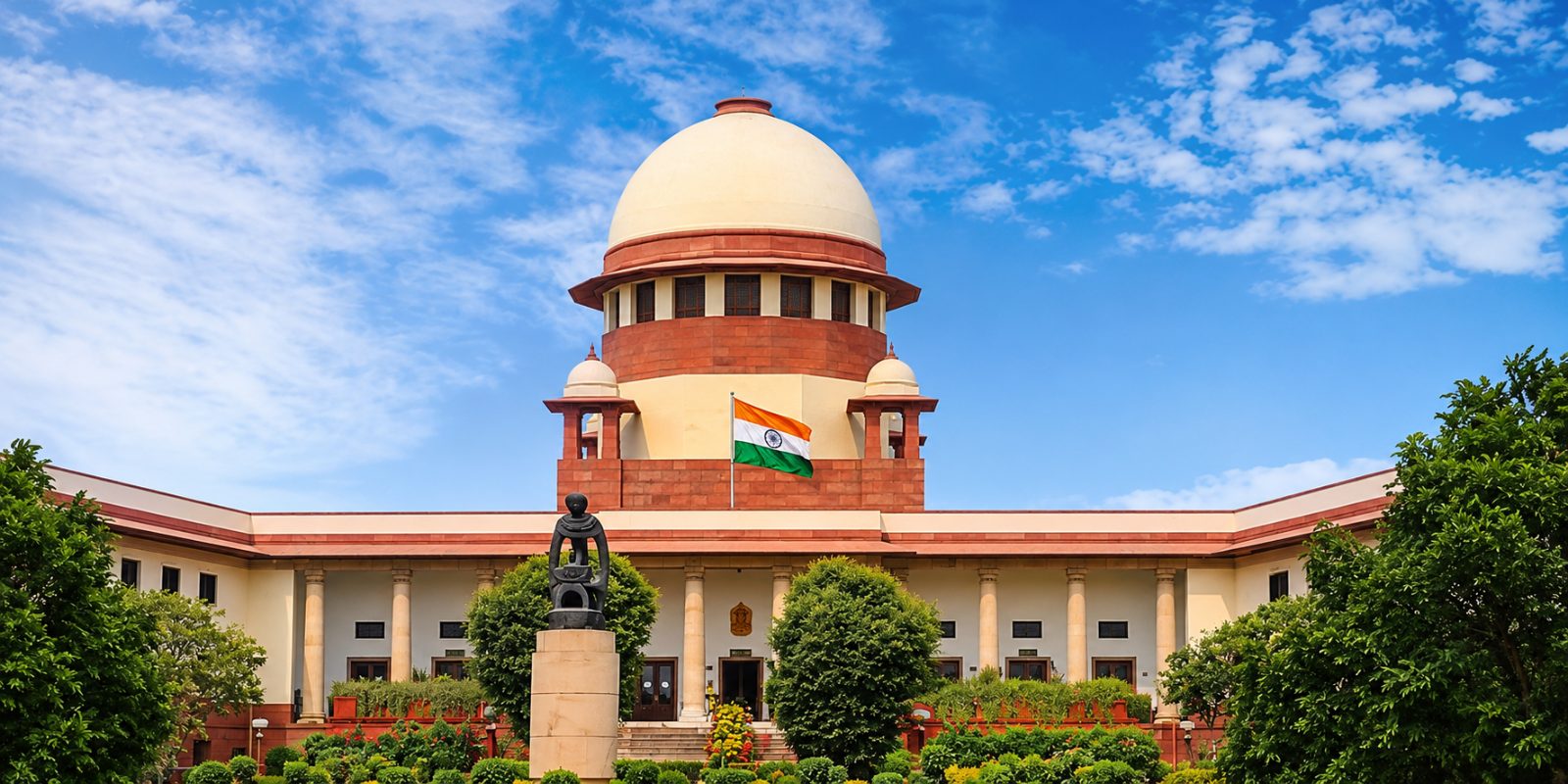
The practice
From the Patna High Court to the Supreme Court.
The Supreme Court of India hears appeals from High Courts and tribunals, writ petitions for the enforcement of fundamental rights, and petitions to transfer cases between States. Most matters reach it through a petition for special leave to appeal under Article 136 of the Constitution, which the Court may grant or refuse in its discretion.
For cases that begin in Bihar, the usual route is from the trial court at Motihari or another district to the Patna High Court, and from the High Court to the Supreme Court. Petitions in the Supreme Court are filed through an Advocate-on-Record, an advocate qualified under the Supreme Court Rules, 2013 to file and conduct matters in that Court.
Who this page is for
This page explains the Supreme Court’s jurisdiction in plain language: the remedy usually available in common situations, the time limits, the documents the Court requires, and how a matter moves from filing to judgment. It is general information; the remedy in a particular case depends on its record.
Common situations
Twenty-four situations, and the Supreme Court remedy for each.
The remedy usually available in the Supreme Court in common situations, with the documents it generally needs. Every matter turns on its own facts and record.
High Court dismisses a quashing petition, criminal revision or appeal
SLP (Criminal) under Article 136
A special leave petition may be filed against any judgment or order of the High Court. Leave is discretionary: the Court usually looks for a substantial question of law, a grave injustice or a departure from settled principles.
Usually needed: Certified copy of the High Court order, FIR, chargesheet and trial court orders
Read: Special Leave Petitions: When and How to Approach the Supreme CourtBail refused by the High Court
SLP (Criminal) against refusal of bail
The Court examines whether the High Court applied the settled considerations: the nature of the accusation, the evidence, the period of custody, the likely length of trial, and the risk of absconding or tampering with evidence. Interim bail may be sought with the petition.
Usually needed: High Court order, custody certificate, chargesheet if filed, earlier bail orders
Read: Regular Bail: Important Procedural ConsiderationsAnticipatory bail refused by the High Court
SLP (Criminal) with an application for interim protection
The petition may be accompanied by an application for protection from arrest until the next date. The Court applies the principles in Sushila Aggarwal v. State (NCT of Delhi) (2020), including that anticipatory bail need not ordinarily be limited in time.
Usually needed: High Court order, FIR, any notice received from the police
Read: Anticipatory Bail in India: Process, Considerations and DocumentsBail granted, and the complainant or the State is aggrieved
SLP for setting aside or cancellation of bail
The Court distinguishes between setting aside a bail order that ignored relevant material, and cancelling bail because of misconduct after release, such as threatening witnesses.
Usually needed: Bail order, FIR, material on conduct after release
Conviction upheld by the High Court in appeal
SLP (Criminal) with an application for exemption from surrendering
A petitioner sentenced to imprisonment must ordinarily surrender before the petition is heard, unless the Court grants exemption on an application. Suspension of sentence and bail during the appeal may also be sought.
Usually needed: Trial court and High Court judgments, custody certificate, proof of surrender or exemption application
Read: Criminal Appeals in the Patna High Court: Suspension of Sentence and Bail Pending AppealHigh Court reverses an acquittal and imposes a severe sentence
Criminal appeal as of right
Under Article 134(1)(a) of the Constitution and the Supreme Court (Enlarging of Criminal Appellate Jurisdiction) Act, 1970, an appeal lies as of right where the High Court, on appeal, reverses an acquittal and sentences the accused to death, imprisonment for life or imprisonment for ten years or more.
Usually needed: Trial court and High Court judgments, evidence record, custody certificate
Death sentence confirmed by the High Court
Criminal appeal; review heard in open court
Death sentence cases come before the Court in appeal. In Mohd. Arif v. Registrar, Supreme Court of India (2014), the Court held that review petitions in death sentence cases must be heard orally in open court.
Usually needed: Complete trial record, mitigation material
Unlawful detention or violation of a fundamental right
Writ Petition (Criminal) under Article 32
Article 32 allows a person to move the Supreme Court directly to enforce fundamental rights, including by habeas corpus against unlawful detention. The Court often asks whether the High Court under Article 226 is the more appropriate forum.
Usually needed: Detention order or arrest memo, representations made, relevant orders
Read: Writ Petitions Under Article 32 and Article 226: Choosing the Right CourtSeveral FIRs in different States on the same allegations
Article 32 petition for clubbing or quashing of FIRs
In T.T. Antony v. State of Kerala (2001), the Court held that a second FIR on the same incident is generally impermissible. The Court may direct that later FIRs be treated as statements in the first, or transfer them to one place.
Usually needed: Copies of all FIRs, notices and orders
A fair trial is not possible in the present State
Transfer Petition (Criminal) under Section 446 BNSS
The Supreme Court may transfer a criminal case or appeal from one High Court, or a court subordinate to it, to another, where it is expedient for the ends of justice (Section 446 BNSS, formerly Section 406 CrPC).
Usually needed: Case details, material showing the apprehension, orders passed in the case
Divorce or custody case filed by the spouse in another State
Transfer Petition (Civil) under Section 25 CPC
A spouse facing matrimonial proceedings in a distant State may seek transfer to the court where she or he lives. The Court weighs the convenience of both parties, the care of children, distance, cost and safety. Mediation is often attempted at this stage.
Usually needed: Copy of the petition filed by the spouse, proof of residence, details of income and children
Read: Transfer Petitions in the Supreme Court: Moving a Case to Another StateMarriage has broken down and cases are pending in several courts
Article 142: complete justice
In Shilpa Sailesh v. Varun Sreenivasan (2023), a Constitution Bench held that the Supreme Court may dissolve a marriage that has irretrievably broken down, and close connected proceedings, in exercise of its power under Article 142.
Usually needed: Details of all pending cases, settlement terms where agreed
Read: Irretrievable Breakdown of Marriage: When the Supreme Court Can Grant Divorce Under Article 142High Court dismisses a second appeal in a property or land dispute
SLP (Civil)
Civil SLPs against High Court decisions in second appeals, revisions and writs are common in title, partition, possession and land-record disputes. The Court usually entertains them where a substantial question of law, or a serious error in reading the record, arises.
Usually needed: Certified copies of all three judgments, plaint, written statement, key title documents
Service matter decided by the High Court
SLP (Civil) in service matters
Disputes on dismissal, seniority, promotion, regularisation and pension, decided by the High Court in writ petitions or after a tribunal, may be carried to the Supreme Court.
Usually needed: High Court judgment, service record, the rules relied on
Land acquisition or compensation decided by the High Court
SLP (Civil) or Civil Appeal
Disputes about compensation, the purpose of acquisition or lapse of proceedings, including under the Right to Fair Compensation and Transparency in Land Acquisition, Rehabilitation and Resettlement Act, 2013, may be taken to the Supreme Court.
Usually needed: Award, reference court and High Court judgments
Order of a tribunal with a direct appeal to the Supreme Court
Statutory civil appeal
Several laws provide a direct appeal: from the National Company Law Appellate Tribunal under Section 62 of the Insolvency and Bankruptcy Code, 2016 (within 45 days); from the National Consumer Disputes Redressal Commission under Section 67 of the Consumer Protection Act, 2019 (within 30 days, with a deposit of fifty per cent of the amount ordered); and from the National Green Tribunal under Section 22 of the National Green Tribunal Act, 2010 (within 90 days).
Usually needed: Tribunal order and record of proceedings
Election petition decided by the High Court
Appeal under Section 116A, Representation of the People Act, 1951
An appeal against an order of the High Court in an election petition lies to the Supreme Court within thirty days of the order.
Usually needed: Judgment and record of the election petition
High Court punishes a person for contempt
Appeal under Section 19, Contempt of Courts Act, 1971
An appeal lies as of right against an order punishing for contempt. Where the order is of a single judge, the appeal lies to a Division Bench of the High Court; from a Division Bench, it lies to the Supreme Court.
Usually needed: Contempt order and the underlying orders
A Supreme Court judgment contains an error apparent on the record
Review Petition under Article 137
A review petition is filed within thirty days of the judgment under Order XLVII of the Supreme Court Rules, 2013, and is ordinarily decided by circulation in chambers without oral hearing. It is not a rehearing of the appeal.
Usually needed: Certified copy of the judgment, statement of the error relied on
Review dismissed, but there is a gross miscarriage of justice
Curative Petition
Recognised in Rupa Ashok Hurra v. Ashok Hurra (2002) for exceptional cases, such as a breach of natural justice or a judge’s failure to disclose a connection suggesting bias. A Senior Advocate must certify that the petition meets these requirements.
Usually needed: Judgment, order dismissing review, Senior Advocate’s certificate
Petition filed late, or relief needed in a pending or decided case
Application for condonation of delay and other applications
Applications are filed for condonation of delay, exemption from filing a certified copy, permission to file additional documents, early listing, stay, or clarification or modification of an order. Each must set out the facts that justify the relief.
Usually needed: Affidavit explaining the delay or the need, supporting documents
Long custody under a special law such as the UAPA or the PMLA
SLP (Criminal) seeking bail on Article 21 grounds
In Union of India v. K.A. Najeeb (2021), the Court held that statutory limits on bail do not take away the power of constitutional courts to grant bail where prolonged custody and delay in trial violate Article 21.
Usually needed: Custody certificate, status of trial, number of witnesses examined
Read: Bail Under the PMLA: Section 45 Twin Conditions and How Courts Apply ThemA question of public importance affecting many people
Public interest litigation under Article 32
The Court entertains public interest petitions for persons who cannot approach it themselves. In State of Uttaranchal v. Balwant Singh Chaufal (2010), it laid down guidelines to discourage petitions filed for private or publicity motives.
Usually needed: Research and documents supporting the public cause
The opposite party is expected to file an SLP
Caveat
A party who expects a special leave petition against an order in its favour may lodge a caveat in the Supreme Court, so that it is heard before any interim order is passed against it.
Usually needed: Copy of the order, details of the expected petitioner
Case types
Case types in the Supreme Court.
Special Leave Petition (Civil)
Petition for leave to appeal against civil judgments of High Courts and tribunals under Article 136.
Special Leave Petition (Criminal)
Against criminal judgments and orders, including bail, quashing and convictions.
Civil Appeal
Statutory appeals, appeals on a certificate under Article 133, and SLPs in which leave is granted.
Criminal Appeal
Appeals as of right under Article 134 and the 1970 Act, on a certificate, and SLPs in which leave is granted.
Writ Petition (Civil)
Article 32 petitions to enforce fundamental rights, including public interest petitions.
Writ Petition (Criminal)
Habeas corpus, clubbing of FIRs, transfer of investigation and other criminal-side writs.
Transfer Petition (Civil)
Transfer of civil and matrimonial cases between States (Section 25 CPC), and of cases raising common questions (Article 139A).
Transfer Petition (Criminal)
Transfer of criminal cases and appeals between States (Section 446 BNSS).
Review Petition
Review of the Supreme Court’s own judgments and orders under Article 137.
Curative Petition
An exceptional remedy after dismissal of a review petition (Rupa Ashok Hurra, 2002).
Contempt Petition
For wilful disobedience of the Supreme Court’s orders, under Article 129.
Miscellaneous and Interlocutory Applications
Clarification, modification, stay, condonation of delay and exemption, in pending and decided matters.
In detail
Supreme Court work, explained.
Criminal special leave petitions
Article 136 allows the Supreme Court, in its discretion, to grant special leave to appeal from any judgment, decree, determination, sentence or order of any court or tribunal in India, except tribunals under laws relating to the Armed Forces. It is not a regular appeal and creates no right of appeal; the Court uses the power sparingly, in cases involving substantial questions of law or grave injustice.
Criminal SLPs commonly arise from orders refusing to quash an FIR or complaint, orders in revision, judgments confirming or reversing convictions, and bail orders. The petition is filed within ninety days of the High Court’s judgment, or sixty days of an order refusing a certificate of fitness, with an application for condonation if there is delay.
SLPs against refusal of bail and anticipatory bail
Bail matters are among the most frequent criminal SLPs. The Court reviews whether the High Court considered the relevant factors and ignored irrelevant ones; it does not ordinarily reassess the evidence in detail at this stage.
Decisions frequently relied on include Satender Kumar Antil v. CBI (2022), on categories of offences and avoiding unnecessary arrest; Sushila Aggarwal v. State (NCT of Delhi) (2020), on anticipatory bail without a fixed time limit; and Union of India v. K.A. Najeeb (2021), on prolonged custody under special statutes.
Criminal appeals before the Supreme Court
A criminal appeal reaches the Supreme Court in three ways: as of right, where the High Court on appeal reverses an acquittal and imposes a sentence of death, life imprisonment or ten years or more (Article 134(1)(a) and the 1970 Act); on a certificate of the High Court under Articles 134(1)(c) and 134A; or by special leave under Article 136, after which the SLP is registered as a criminal appeal.
In an appeal, the Court can examine the evidence, but it generally does not disturb concurrent findings of fact unless they are perverse or unsupported by evidence. Suspension of sentence and bail during the appeal are sought by separate application.
Transfer petitions in matrimonial disputes
Under Section 25 of the Code of Civil Procedure, 1908, the Supreme Court may transfer a suit, appeal or other proceeding from a court in one State to a court in another, if it is expedient for the ends of justice. Matrimonial cases, including divorce, restitution and custody proceedings, form a large share of these petitions.
The Court generally considers the convenience of the wife, the care of minor children, the distance and cost of travel, and safety. A reference to the Supreme Court Mediation Centre is common when notice is issued.
Civil SLPs in property, land and service matters
Civil SLPs challenge High Court judgments in second appeals, civil revisions, first appeals and writ petitions. Cases from Bihar commonly concern title and partition suits, possession, mutation and land-survey disputes, land acquisition, tenancy, and service matters such as dismissal, seniority, regularisation and pension.
Because a second appeal in the High Court is itself limited to substantial questions of law (Section 100 CPC), the Supreme Court looks closely at whether such a question was correctly framed and answered. Concurrent findings of fact are seldom disturbed.
Review and curative petitions
A review petition under Article 137, read with Order XLVII of the Supreme Court Rules, 2013, lies in civil cases on grounds similar to Order XLVII of the Code of Civil Procedure, and in criminal cases on an error apparent on the face of the record. It is filed within thirty days and is ordinarily decided by circulation, without oral arguments, by the same bench where available.
A curative petition, recognised in Rupa Ashok Hurra v. Ashok Hurra (2002), is available only after a review is dismissed, on narrow grounds such as a breach of natural justice or a judge’s failure to disclose a connection suggesting bias. It needs a certificate from a Senior Advocate and is first circulated to the three senior-most judges and the judges who decided the case, where available.
Article 32 writ petitions
Article 32 is itself a fundamental right: the right to move the Supreme Court to enforce the rights in Part III of the Constitution. The Court may issue directions, orders or writs, including habeas corpus, mandamus, prohibition, quo warranto and certiorari.
In practice, the Court often directs petitioners to approach the High Court under Article 226 first, unless the matter involves rights across several States, a question of national importance, or other exceptional circumstances.
Advocates-on-Record and filing
Under Order IV of the Supreme Court Rules, 2013, only an Advocate-on-Record may file an appearance or act for a party in the Supreme Court; other advocates may appear and argue when instructed by an Advocate-on-Record. A party may also appear in person, subject to the Rules.
Petitions are filed physically or through the Court’s e-filing portal, checked by the Registry for defects, and listed before a bench once the defects are cured. Documents in languages other than English must be accompanied by English translations.
How a Supreme Court matter moves
From the certified copy to the judgment.
- 1
Certified copy and record
Obtain the certified copy of the judgment under challenge and the record of the courts below. If the certified copy is not yet available, an application for exemption may be filed with the petition.
- 2
Limitation
An SLP is filed within ninety days of the High Court’s judgment, or sixty days of an order refusing a certificate of fitness. A later filing needs an application explaining the delay.
- 3
Drafting
The petition contains a synopsis and list of dates, the questions of law, the grounds, a declaration about other proceedings, an affidavit, and the documents as annexures.
- 4
Filing through an Advocate-on-Record
The petition is filed in the Registry, physically or by e-filing, and checked for defects, which must be cured before the matter is listed.
- 5
Admission hearing
The matter is listed before a bench, which may issue notice to the other side, grant interim relief, or dismiss the petition at the threshold.
- 6
Pleadings after notice
The respondent files a counter affidavit and the petitioner a rejoinder. If leave is granted, the SLP is registered as a civil or criminal appeal.
- 7
Final hearing and judgment
The appeal is heard on a regular hearing day and decided by judgment. Review and curative remedies after that are narrow.
Listing dates and outcomes are for the court to decide. The firm does not predict or promise either.
Frequently before the court
The Constitution and the rules that govern the Court.
Article 32
Right to move the Supreme Court to enforce fundamental rights.
Article 129
The Supreme Court as a court of record, with power to punish for its contempt.
Articles 132 to 134A
Appeals from High Courts in constitutional, civil and criminal cases, including on a certificate.
Article 136
Special leave to appeal from any court or tribunal, in the Court’s discretion.
Article 137
Power to review its own judgments and orders.
Article 139A
Withdrawal and transfer of cases raising the same substantial questions of law.
Article 141
Law declared by the Supreme Court binds all courts in India.
Article 142
Power to pass any decree or order necessary for complete justice.
Section 25 CPC
Transfer of civil suits, appeals and proceedings between States.
Section 446 BNSS
Transfer of criminal cases and appeals (formerly Section 406 CrPC).
Supreme Court Rules, 2013
Filing, limitation, Advocates-on-Record, review petitions and listing.
Supreme Court (Enlarging of Criminal Appellate Jurisdiction) Act, 1970
Appeals as of right where the High Court reverses an acquittal and imposes a severe sentence.
हिंदी में
सर्वोच्च न्यायालय में मामला: सरल भाषा में
पटना उच्च न्यायालय के निर्णय या आदेश के विरुद्ध सामान्यतः सर्वोच्च न्यायालय में विशेष अनुमति याचिका (SLP) दाखिल की जाती है। यह संविधान के अनुच्छेद 136 के अंतर्गत न्यायालय के विवेक पर निर्भर है; यह अपील का स्वतः अधिकार नहीं है।
SLP सामान्यतः उच्च न्यायालय के निर्णय की तिथि से 90 दिनों के भीतर दाखिल की जाती है। सर्वोच्च न्यायालय में याचिका एडवोकेट-ऑन-रिकॉर्ड के माध्यम से दाखिल होती है।
मौलिक अधिकारों के उल्लंघन पर अनुच्छेद 32 के अंतर्गत रिट याचिका, विवाह संबंधी मामले को दूसरे राज्य में स्थानांतरित कराने के लिए स्थानांतरण याचिका, और सर्वोच्च न्यायालय के निर्णय में स्पष्ट त्रुटि होने पर 30 दिनों के भीतर पुनर्विलोकन (रिव्यू) याचिका दाखिल की जा सकती है।
सामान्यतः आवश्यक दस्तावेज़
- उच्च न्यायालय के निर्णय की प्रमाणित प्रति
- निचली अदालतों के निर्णय और आदेश
- आपराधिक मामलों में FIR, आरोप-पत्र और हिरासत प्रमाण-पत्र
- हिंदी दस्तावेज़ों का अंग्रेज़ी अनुवाद
यह सामान्य कानूनी जानकारी है; इसे किसी विशेष मामले में कानूनी सलाह न मानें।
Documents usually needed
Checklist · 7- Certified copy of the judgment or order under challenge, or an application for exemption
- Copies of the judgments and orders of the courts below
- Pleadings and key documents filed before the High Court
- In criminal matters: the FIR, the chargesheet, and a custody certificate from the jail where the petitioner is held
- English translations of documents in Hindi or other languages
- Vakalatnama in favour of the Advocate-on-Record, and a supporting affidavit
- Details of any earlier petition filed in the Supreme Court in the same matter
Please do not send Aadhaar numbers, bank credentials or original documents through the website.
Frequently asked questions
What is a Special Leave Petition (SLP)?
A petition under Article 136 of the Constitution asking the Supreme Court for permission to appeal against a judgment or order of a High Court or tribunal. Leave is discretionary; if it is granted, the petition is heard as an appeal.
What is the time limit for filing an SLP?
Ninety days from the date of the High Court’s judgment, or sixty days from an order refusing a certificate of fitness, under the Supreme Court Rules, 2013. Delay may be condoned on a sufficient explanation.
Does filing an SLP stay the High Court’s order?
No. Filing does not operate as a stay. Interim relief must be sought by application and is granted only if the bench considers it appropriate.
Can the Supreme Court grant bail?
Yes. Bail matters reach the Supreme Court mainly through SLPs against High Court orders, and the Court may also grant interim bail or protection while an SLP or appeal is pending.
Who can file a case in the Supreme Court?
Petitions are filed through an Advocate-on-Record under Order IV of the Supreme Court Rules, 2013. A party may also appear in person, subject to the Rules.
What is the difference between a review and a curative petition?
A review under Article 137 is filed within thirty days to correct an error apparent on the record. A curative petition, recognised in Rupa Ashok Hurra v. Ashok Hurra (2002), is an exceptional remedy after a review is dismissed, on very narrow grounds.
Can a matrimonial case be transferred to another State?
Yes. The Supreme Court may transfer it under Section 25 of the Code of Civil Procedure if it is expedient for the ends of justice; the convenience of the wife and the care of children are often given weight.
This page gives general information about Supreme Court procedure. It is not legal advice on any individual matter, and it does not create an advocate–client relationship.